
Project Name: Solana
Project Ticker: SOL
Website: solana.com
Twitter Account: twitter.com/solana
Whitepaper: Click here for the whitepaper.
What Is Solana?
In short, Solana is a fast, secure, and scalable blockchain. Solana contains many decentralized applications (DApps) and platforms. Solana is an open-source project. The ideas behind Solana emerged in 2017 and Solana was officially introduced in March 2020.
What Does Solana Offer?
Solana, one of the fastest blockchains in the world today, supports 65,000 TPS (transactions per second). The Solana network has about 900 validators. One of the innovations that Solana has brought to Blockchain Technology is the Proof of History (PoH) developed by Anatoly Yakovenko. With this method, shareholders in the network leave a historical record of a transaction and are responsible for that transaction. Thanks to this method, Solana offers high scalability.
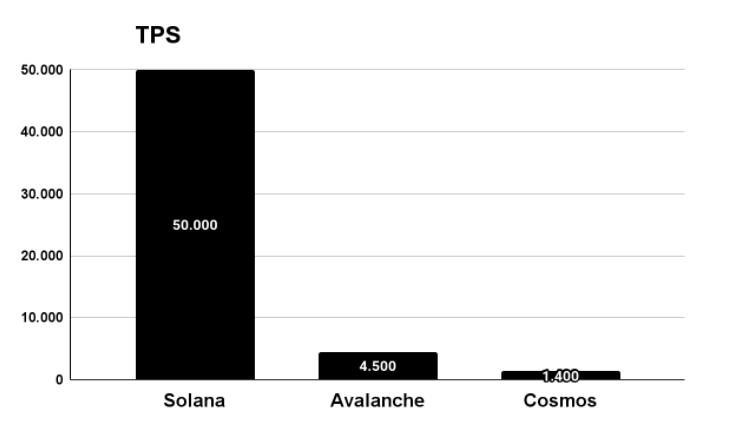
High scalability is related to TPS. Bitcoin can process 7 to 8 transactions per second. Ethereum can process 15 to 20 transactions per second with its current version. Solana should be compared to its close competitors instead of Bitcoin and Ethereum because both Bitcoin and Ethereum have a low TPS problem. The graph below shows the TPS capacities of Solana, Avalanche and Cosmos. Solana can process 50,000 to 65,000 transactions per second, while Avalanche can process 4,500 transactions, and Cosmos can process 1,400 transactions.
Another important aspect of scalability is to achieve high transaction speed with as low transaction fees as possible. Users do not approve of high transaction fees. Given the problems that the Ethereum network has faced recently, we can say that high transaction fees can reduce network usage. Solana has a big advantage over its competitors. On the Ethereum network, the blockchain with the largest ecosystem, transaction fees have risen to $40 in 2021. This has caused users to turn to Ethereum's competitors, and Solana is one of them. When we examine the official Solana website and the block explorers where we can check transactions on Solana, we see that the average transaction fee is approximately $0.0005.
The number of validators is important for a blockchain. As we mentioned in our article about the Blockchain Trilemma, security and decentralization largely depend on the number of shareholders in the network. The number of independent validators from various parts of the world directly affects the security of blockchains. Solana has 896 validators worldwide, while Avalanche has 931 and Cosmos has 159.
Solana’s Technology
One of the most important aspects of Solana's technology is that it is highly scalable compared to other blockchains without the need for Sharding or Layer-2 solutions. As we have mentioned above, Solana supports up to 65,000 TPS. Solana is a highly efficient blockchain compared to its competitors with a block time of 400 ms. The innovation that Solana brings is thanks to the Proof of History.
Proof of History
One of the biggest problems both Proof of Work and Proof of Stake have is that validators need time to confirm each other. These validators reach a consensus among themselves, and this process takes time. The Proof of History consensus mechanism creates historical records that prove that an event took place on a specific date.
Solana’s Speed
Solana is fast thanks to the “leaders” in the network. These leaders are constantly changing among validators. A leader transmits transactions over the network in the fastest way possible. Leaders need to be well-equipped. But this raises questions about the decentralization of the Solana network. The stronger the leaders' equipment, the faster the Solana network works. Concerns about decentralization stem from criticism that these leaders may not have good intentions. However, there are validators who control leaders. If two-thirds or more of the validators notice that a leader is malicious, the leader is dismissed, and another validator becomes the new leader. Therefore, the hardware power required to be a validator in the Solana network is quite high. Some of the requirements listed on the Solana website are:
CPU: 12 cores, 2.8 GHz
RAM: 128GB or more, motherboard with 256GB capacity
Disk: 500GB or more
The Solana Team & Company
Solana's co-founder, Anatoly Yakovenko, was at Qualcomm for nearly 13 years before Solana. During this period, Yakovenko rose to the position of Senior Staff Engineer Manager. He worked as a software engineer at Mesosphere and Dropbox until 2017. Yakovenko studied Computer Science at the University of Illinois in 1999.
Solana's Co-Founder and CTO Greg Fitzgeral and Anatoly Yakovenko share a common history dating back to the University of Illinois and Qualcomm. Fitzgerald worked as a software engineer at Qualcomm until March 2018 and joined the Solana team after that date. Fitzgerald, who studied Computer Engineering, specializes in the customization of software languages and distributed systems.
Solana's Co-Founder Raj Gokal studied economics and finance. Gokal, who has been involved in the establishment of many projects before, has also extensive experience in management. Raj Gokal, who implemented the Solana project with Anatoly Yakovenko in 2017, is currently Solana’s COO (Chief Operating Officer).
Solana’s Digital Asset Economy
After Solana was introduced as an idea in 2017, the Solana ICO took place in March 2020. Solana managed to raise $25,660,000 by accepting both USD and USDC during the ICO. As of May 7, 2021, Solana ranks 18th in terms of market capitalization at $11,581,436,267.
Date of the ICO: March 2020
Ticker: SOL
ICO Price: 1 SOL = 0.22 USD
Maximum Supply: 500.000.000 SOL
The Solana Ecosystem & Collaborations
Solana collaborates with many cryptocurrency projects and its ecosystem is growing every day. There are many existing and newly added projects in the Solana ecosystem, which have recently attracted the attention of developers and capital owners. These projects include Serum, Raydium, Band Protocol, and ChainLink, which are in the field of DeFi (decentralized finance). The Solana ecosystem, which includes many wallet integrations such as Exodus, TrustWallet, Solletio, and Ledger, will soon add new wallet options.

Serum (SRM)
Serum is a decentralized exchange (DEX) built on the Solana blockchain. Taking advantage of the Solana blockchain, Serum offers fast transactions and low transaction fees. SRM is Serum’s native cryptocurrency. Serum serves as Solana's decentralized exchange platform and plays a key role in the Solana ecosystem.
Raydium (RAY)
Raydium is an Automated Market Maker (AMM) and liquidity provider built on the Solana blockchain. Unlike other AMMs, Raydium provides on-chain liquidity to a centralized limit order book, meaning that funds deposited on Raydium are converted into limit orders in Serum’s order books.
Maps (MAPS)
The MAPS Token is the native cryptocurrency of MAPSME, a map and navigation application. MAPSME, an open-source application, allows users to access offline maps. Users can contribute to the development of the application. The app has millions of users worldwide. Therefore, it needs a fast and scalable network, which is possible thanks to Solana. The MAPS Token runs on the Solana network.
Band Protocol (BAND)
Band Protocol is a cross-chain data oracle platform that combines real-world data and APIs and connects them to smart contracts. Band Protocol is integrated with Solana.
Chainlink (LINK)
With Chainlink, Solana plans to develop a high-frequency oracle that can be used for binary options trading. This development plan includes Solana's partner model that updates prices every 400 MS with developers who create decentralized finance (DeFi) assets and marketplaces using the platform.
Evaluation of Solana
Solana aims to solve the problem of scalability, one of the biggest problems facing blockchains today, with the Proof of History (PoH) created by Anatoly Yakovenko, the founder of Solana. Solana is ahead of many blockchains in terms of scalability with a capacity of 65,000 TPS and a block time of 400 MS. What's more, Solana makes all this possible with low transaction fees. The average transaction fee in Solana is $0.0005. With its ever-growing ecosystem, Solana is home to many decentralized finance (DeFi) applications. In addition to its many advantageous features, it is worth noting that the minimum hardware required to run a validator on the Solana network is quite high. Solana not only has a prominent place in the cryptocurrency ecosystem with its developments and innovations, but also surpasses many of its competitors among blockchains.


